
Latest News

Hayley Nelson, Chair of the Priority One Tauranga Moana Investment Attraction Group, offers insights around our inaugural Investment Summit, noting that regional alignment and capital already exist, now we need coordination, vision and visibility.
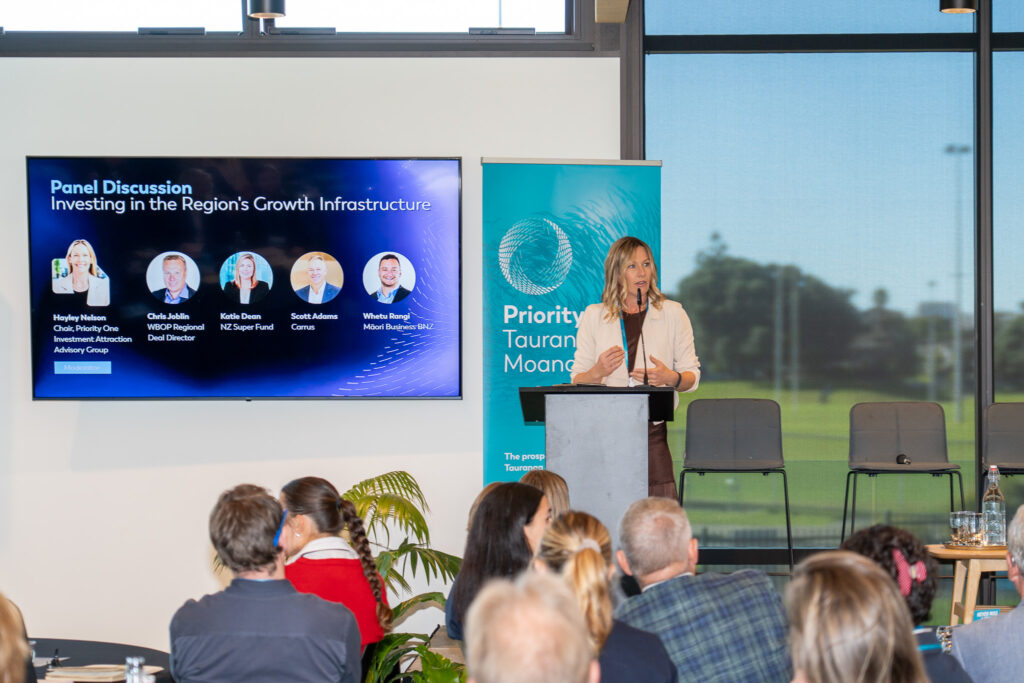
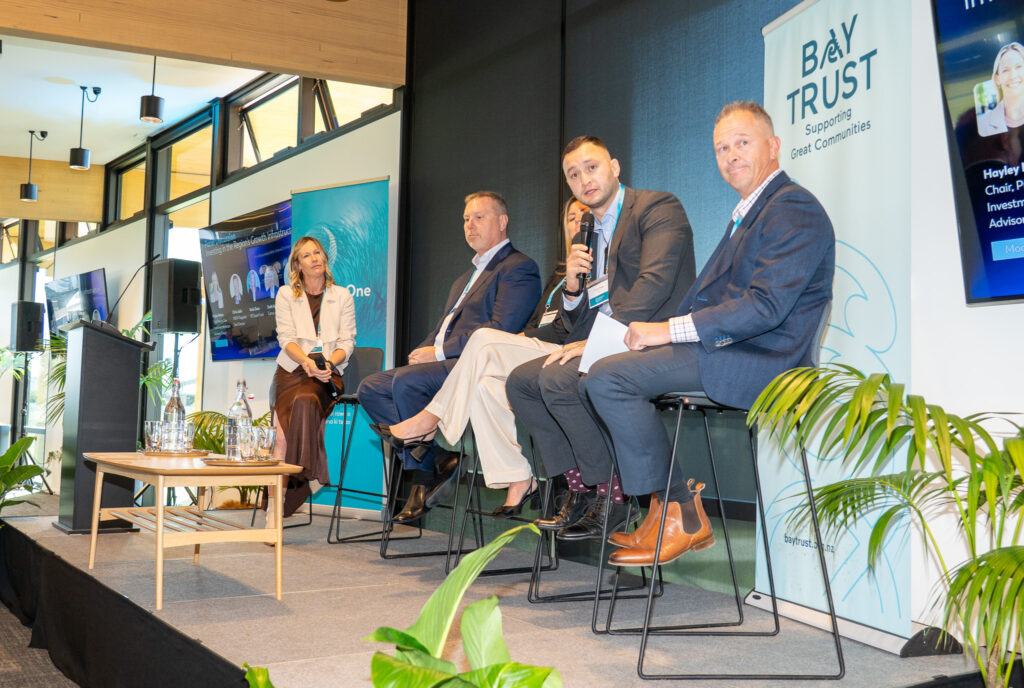
Recently, I had the opportunity to be part of Priority One’s inaugural Investment Summit, not just as an attendee, but as the moderator of the Investing in the Region’s Growth Infrastructure panel discussion. The timing of the summit aligned with the signing of the Western Bay of Plenty Regional Deal earlier that same day. It felt like a significant moment for everyone who lives in the Western Bay, with benefits that will extend well beyond our own region, into the wider Bay of Plenty and New Zealand as a whole.
Why does this matter? Because as one of the country’s fastest growing cities, home to New Zealand’s largest port and a diverse and evolving economy, we are at a pivotal point in our growth story. We have an opportunity right now to collectively shape an even greater place to live, work, learn and play, supported by momentum and alignment across local government, central government, iwi, industry and importantly, our wider community.
As Chair of the Priority One Tauranga Moana Investment Attraction Group, I have had the privilege of working alongside leaders from across our regional investment ecosystem. The focus of this group is clear. We want to build and coordinate a high performing investment ecosystem that connects capital to scalable regional opportunities and strengthens Tauranga Moana’s position as New Zealand’s trade gateway.
By creating stronger connections across industry, iwi, government, education, professional services and investors, we can unlock many of the opportunities discussed throughout the summit. This includes improving visibility of real investment opportunities, sharing industry insights and challenges, supporting Māori investment partnerships and developing the talent pipeline needed for long term growth within financial and investment services.
Importantly, this is not simply about attracting capital for the sake of it. It is about ensuring investment creates meaningful economic, social and community impact. It is about advocating for transformational projects such as the city centre, Tauriko, Rangiuru and Te Tumu, and ensuring they are supported by forums and engagement channels that accelerate investment confidence and deployment. It is also about recognising and showcasing the capability that already exists locally within our professional services sector. Too often there can be a tendency to look externally for expertise when we have highly capable people and firms right here in our own region who deeply understand our communities, our opportunities and our challenges.
One of the questions raised recently at a hui was what makes this group different? It is a fair question. There have been several iterations of investment and advocacy groups over the years, including one remembered by many through the phrase “magnetic city”.
What feels different now is the alignment. We now have a bipartisan Regional Deal, long-term commitment from key stakeholders and a genuine desire across our region to create intergenerational change that is sustainable both now and into the future. There is a willingness to work together, to continue the conversations and to learn from the past in order to create a better path forward. Ka mua, ka muri. We walk backwards into the future with our eyes fixed on the past.
We also need to continue developing a strong and credible narrative about who we are as a region. One that positions Tauranga Moana as New Zealand’s trade gateway and a region open for investment. One that highlights opportunities across growth sectors, infrastructure, housing and commercial development, while leveraging the momentum of the Regional Deal.
A recurring theme throughout the summit was that significant capital exists and is actively looking for opportunities to invest. What became clear, however, is that many people are still unaware of what investment is already happening or the scale of opportunities already in play.
The NZ Super Fund is a strong example. Through its SuperBuild investment model, it is helping tackle New Zealand’s infrastructure and housing challenges by partnering with government and industry to deliver large-scale infrastructure and urban development projects. Importantly, these are long-term investments that support future retirement savings for New Zealanders, while also helping grow the economy, create jobs and deliver critical infrastructure outcomes.
Locally, we are already seeing this through Kaha Ake, a partnership between the NZ Super Fund and Classic Group, with investment into the soon to be released Riverside neighbourhood in Tauriko. During the panel discussion, Katie Dean, Portfolio Manager, Real Assets at NZ Super Fund, spoke to the importance of long-term partnerships and the role of the private sector in capitalising on government investment to create additional value for the Western Bay.
Scott Adams, Managing Director of Carrus Corporation, also spoke about the opportunities ahead, particularly around Te Tumu in Pāpāmoa East. This approximately 740 hectare development has the potential to deliver thousands of homes supported by resilient infrastructure, transport links, community facilities and public spaces. It is a vision for a connected and liveable community that considers not only the needs of today, though also those of our mokopuna in the future.
The challenge now is unlocking delivery. Reform of the Resource Management Act is expected to play a key role, with proposed legislation focused on enabling development and infrastructure growth while also protecting and enhancing the natural environment.
Chris Joblin, Western Bay of Plenty Regional Deal Director, reinforced the significance of the ten-year partnership model and the opportunities it creates across transport, housing, export growth, social infrastructure and economic diversification.
Whētu Rangi, Head of Māori Business at BNZ, spoke powerfully about the importance of taking a tīkanga-based approach within the Māori economy. One that prioritises intergenerational wellbeing, environmental guardianship and collective prosperity rather than short-term profit maximisation. The importance of including tangata whenua early in conversations was strongly reinforced.
This whakaaro aligns closely with conversations within the Investment Attraction Group around universal returns and the importance of avoiding a “K shaped” economy, where inequality continues to widen. Increasingly, institutional investors want to see investment outcomes that support lower and middle income households, small businesses and diverse communities alongside economic growth.
Ultimately, the future of our region cannot simply be measured by GDP or population growth alone. It must also be measured by whether people feel connected to where they live, whether opportunities exist for all parts of the community and whether future generations inherit a region they are proud to call home.
I am genuinely excited. Excited to be on this waka alongside so many passionate and committed people. Excited for the opportunities ahead. Most of all, excited about what we can create together for the generations that follow.
To learn more about our investment work, and to download our Insights Guide, click here.
Never miss a beat: Join our fortnightly newsletter to keep across Priority One insights, opportunities and events.