
Latest News

In London, the River Thames is more than a piece of geography. It is life-giving, connecting and sustaining. It has shaped the city’s identity, its movement, its economy and its sense of place over generations.
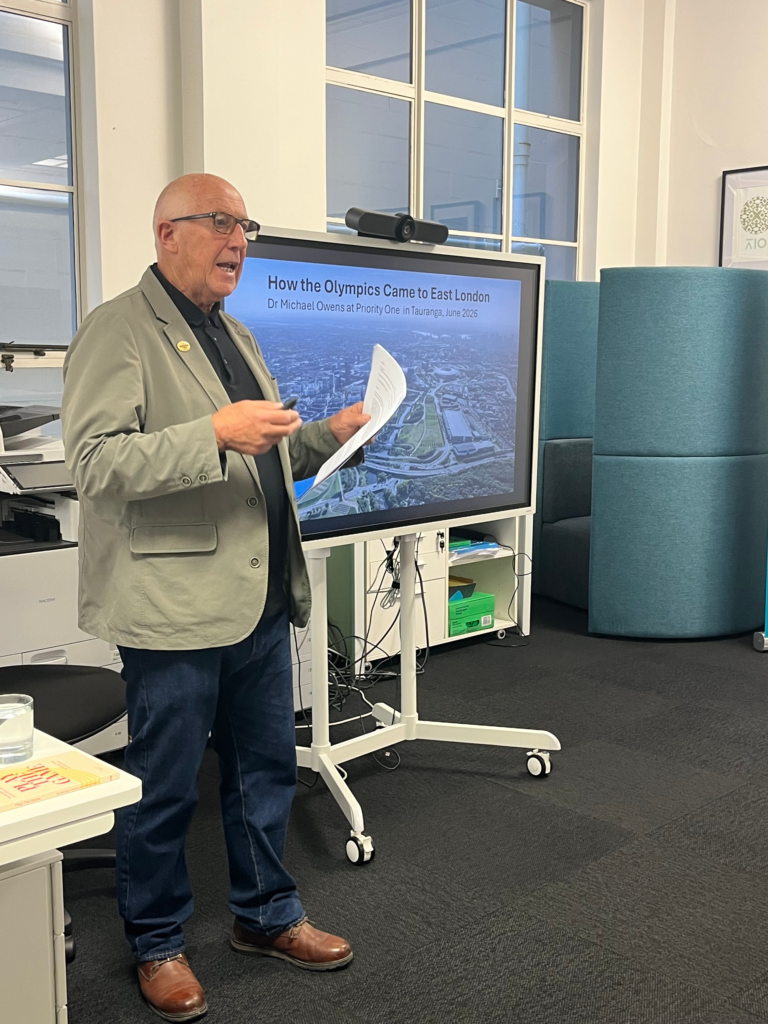
When Dr Michael Owens spoke to local government and business leaders at a recent Priority One event, he used the idea of Water City as a way of thinking about how places grow. Michael played a senior role in London planning and development, including work connected to the site for the 2012 London Olympic Games, and brought a valuable international lens to the conversation.
His reflections were grounded in the complex reality of delivering one of the world’s most significant urban regeneration projects. He spoke about how cities and regions build momentum, align around shared ambition, attract investment, work across public and private sectors, and move complex projects from vision to delivery.
For the Western Bay of Plenty, the timing of this conversation was important. As our region enters a new phase of growth, investment and decision-making, the question is no longer whether we need to scale up. It is how we do it well, and how we bring the right people, projects and investment together to make it happen.
Three key ideas stood out.
First, regions need to move from a series of scattered project proposals to a unified and inclusive vision. Individual projects matter, but they are far more powerful when they are connected to a bigger story about where a region is heading and why that matters.
Second, satellite areas should be understood as connected opportunities, not as a collection of disconnected sites. Growth is not only about what happens in one centre. It is about how places relate to one another, how people move between them, and how investment can strengthen the wider region rather than fragment it.
Third, a successful city or region is one where people, institutions and opportunities reinforce one another. Strong places are shaped not only by infrastructure and investment, but by the relationships, identity and shared purpose that hold them together.
Michael’s insights were not about copying London’s experience. They were a reminder that places grow well when ambition is matched by alignment, and when the story of a region is strong enough to connect people, projects and investment around a shared future.
For the Western Bay of Plenty, that is the opportunity in front of us.
Sign up to Priority One’s fortnightly newsletter featuring expert insights, opportunities and free events here.