
Latest News

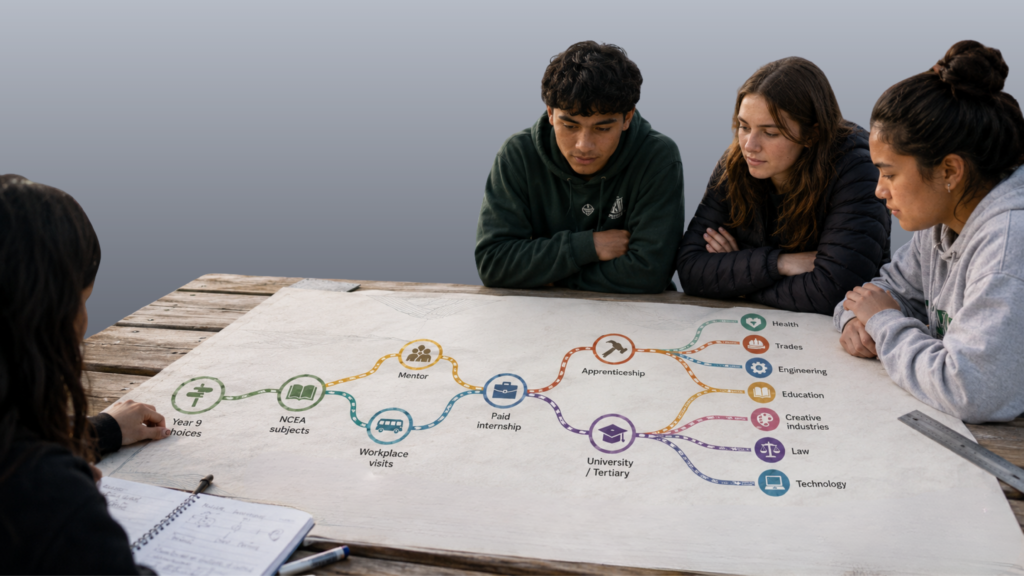
There is a sentence in Pacific Growth’s Rangatahi Insights Report that should stop us in our tracks:
“I didn’t know I needed physics. Now I want to be a doctor and I’m not in the class and it’s too late to fix it this year.”
That is not a lack of ambition. It is not a lack of talent. It is not a lack of work ethic.
It is a lack of visibility.
For all the conversations we have as a region about workforce shortages, skills gaps, talent attraction and future productivity, this report brings us back to something more immediate and more human. Many of the young people who could become our future clinicians, builders, teachers, engineers, entrepreneurs, creatives, tradespeople, emergency responders and leaders are already here. They are already dreaming. They are already naming the futures they want.
The issue is that too many of them cannot see the pathway.
Pacific Growth’s Pasifika Navigators of Tomorrow Rangatahi Insights Report captures the voices of Pacific students who attended the 2026 careers expo at Mercury Baypark Stadium. They were asked two simple questions: what work or career do you dream of doing in the future, and what gets in the way of achieving it?
Their answers matter for Priority One, our members and the wider Western Bay of Plenty because they sit directly at the ‘why’ behind our work: talent, education, business, investment, innovation, sustainability, infrastructure and regional prosperity. All of this depends on a strong, healthy future of work.
We cannot keep talking about talent as something we need to attract from elsewhere while overlooking the talent already sitting in our classrooms and communities. We cannot claim to be building a future-ready region if the young people in that future do not know which subjects they need to take, which doors they are allowed to knock on, or which employers might one day have a place for them.
The report is clear: Pacific rangatahi are not dreaming small. Across the responses, more than 100 distinct career aspirations were named. Health, law, aviation, trades, sport, education, business, science, technology, defence, emergency services, beauty, media, music and creative industries all appeared.
That breadth matters.
A workforce strategy that only celebrates university pathways will miss many of them. A workforce strategy that only talks about trades will miss many of them too. A region that treats sport, service and storytelling as side interests rather than serious career pathways will fail to meet young people where they are.
For Priority One members, this is important. The future workforce does not arrive fully formed at the point of recruitment. It is shaped years earlier, through exposure, confidence, subject choices, role models, family conversations, workplace experiences and the quiet moment when a young person thinks, “maybe someone like me could do that.”
The report also makes one barrier impossible to ignore: money.
Money was the most repeated barrier rangatahi named. Not occasionally. Repeatedly. By itself, circled, underlined, stacked alongside student loans, expenses, financial support and the pressure to help at home.
This should change how we design opportunities.
Unpaid internships, unpaid work experience, unpaid “exposure” and unpaid entry pathways are not neutral. For some young people, they are a closed door dressed up as an opportunity. If a rangatahi is already balancing school, transport, family responsibility and financial pressure, then asking them to work for free in order to prove they deserve a future is not pathway development. It is exclusion.
For employers, this is where the opportunity sits. Paid internships, paid placements, paid holiday work, cadetships, apprenticeships, workplace tasters and structured mentoring are not charity. They are regional talent infrastructure.
They are how we build the workforce we keep saying we need.
The second major barrier was confidence. The report identifies self-doubt, fear of failure, mindset and worrying about what others think as repeated themes. These are the barriers that do not show up in a CV or academic record. They can sit beneath a student’s silence in a classroom, their reluctance to apply, or their decision to choose the familiar path because the bigger one feels too exposed.
Information helps, but information alone is not enough.
A brochure cannot replace a person. A website cannot replace a mentor. A careers talk cannot replace seeing someone from your own community standing inside the future you thought was out of reach.
That is why role models’ matter. Pacific professionals, tradespeople, creatives, leaders, founders, builders, engineers, lawyers, nurses, teachers, technicians and entrepreneurs all have a part to play. Not as inspirational decoration, but as living proof. Visibility reduces the distance between “I want that” and “I can see how to get there.”
The report also reminds us that Pacific career decisions are often family decisions. Aspirations were strongly anchored in giving back, supporting family, honouring culture and staying connected to home. Family also appeared as a barrier, through responsibility, expectation, cost and the difficulty of leaving the people you love.
That is not a problem to solve around. It is a design reality to work with.
If we want young people to step into regional opportunities, families need to be part of the conversation early. Subject choices, tertiary pathways, apprenticeships, student loans, scholarships, workplace expectations and career options should not be explained to rangatahi in isolation. Whānau and aiga need to be in the room, because they are already part of the decision.
This is where Priority One’s role as a connector becomes important.
Our strength is not that we can solve every barrier ourselves. Our strength is that we sit between business, education, local government, iwi, community, investors and regional partners. That gives us a responsibility to help turn insight into action.
For our members, the ask is practical.
Open your doors earlier. Host workplace visits that show the real range of roles inside your organisation. Offer paid short-term experiences. Speak to students before they have made subject choices that close doors. Share the pathways into your industry in plain language. Partner with schools and community organisations. Support mentoring. Help fund scholarships. Think about the young person who does not know what they do not know, then design your involvement around them.
For the region, the challenge is bigger.
We need a visible pathways map that traces priority careers backwards, from the job to tertiary training, apprenticeships, NCEA subjects, Year 9 choices, workplace experience and the support needed along the way. We need to stop treating “career readiness” as something that starts in Year 13. For many pathways, the critical decisions start much earlier.
This matters for our economic future.
If the Western Bay of Plenty wants higher-value jobs, stronger local businesses, a more resilient economy and a workforce that can support future growth, then youth pathways are not a side programme. They are core economic development.
A talent pipeline is not built when a vacancy is advertised. It is built when a young person understands what is possible, what is required, who can help and how to take the next step.
The Rangatahi Insights Report gives us a clear message. Our young people are not empty vessels waiting to be inspired. They already have dreams. They already have motivation. They already carry responsibility, culture, ambition and a desire to contribute.
What they need from us is a region willing to make the pathway visible.
Because “you don’t know what you don’t know” should never be the reason a young person misses their future.