
Latest News

For growing businesses, accessing the right skills at the right time can be challenging – particularly in specialised areas such as engineering, data or applied science. Internships at The University of Waikato offer a practical way to bring emerging talent into an organisation to work on projects that might otherwise sit on the backburner.
Students can contribute to real outcomes, apply technical knowledge, problem-solve and operate in professional environments. For employers, that means focused project support, fresh thinking and a low-risk way to assess future talent.
For startups especially, internships can create capacity – freeing up founders and senior staff to focus on growth, partnerships and commercial priorities.
That was certainly the case for HumBio, which is building a real-time chemical intelligence platform that detects chemical state changes across food production, fermentation, and waste-to-energy systems.
Why a startup took the leap
“It was probably really early to bring on an intern, but we felt if we found the right person, it could be really valuable,” says Aaron Middleton, Co-Founder and Chief Technology Officer at HumBio, a startup based in Mount Maunganui.
Aaron’s motivation was also personal. Before co-founding HumBio, he worked in Defence at BAE Systems in the UK, where he served as a STEM ambassador with the Smallpiece Trust, working with a range of secondary schools to inspire students via engineering and science-based programmes. “I’ve always had a heart for education and inspiring students,” he says.
“Our search for an intern was very last minute as well – we reached out to Waikato University and to Shane Stuart [Priority One Innovation Manager] a few weeks before we wanted someone to start,” says Aaron. “Zach reached out and really rolled up his sleeves and produced some really useful work.
“We are a very small startup, and I’ve been very impressed by his can-do attitude and willingness to give things a try. When we decided to search for an intern late last year, I was conscious our wrap-around support would not be on par with larger companies, but Zach really took the work on in his stride.”
Immediate impact for a small team
For a business operating with a small number of staff, an extra capable set of hands can be transformational. “As a startup, we’re effectively three and a half people – some of us are part-time, so when you bring on an intern, especially Zachary who was very proactive in his approach, it really helped a lot,” says Aaron.
“Zach’s work improved the robustness of our diagnostics in terms of our platform and digitising chemical signals. Once he was up to speed, he really took ownership of his work and it allowed us to refocus on other things. It really helped our efficiency, that’s for sure, and we will certainly stay connected in the future.”
From theory to commercial reality
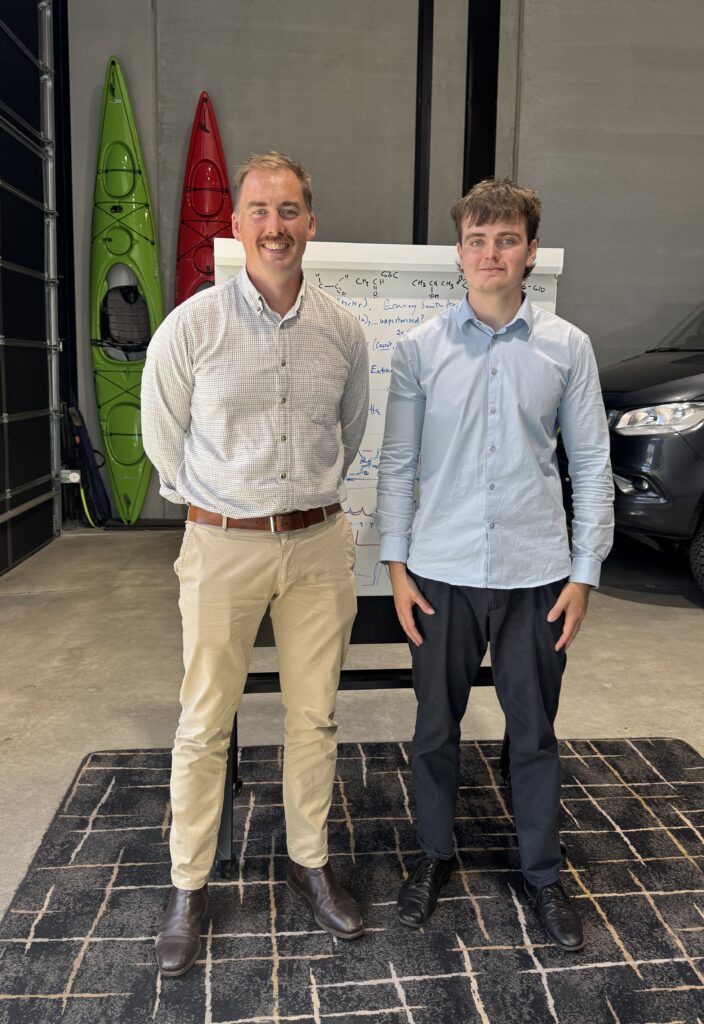
Zach Graham is studying electrical and electronic engineering, now in his fourth (and final) year and his work at HumBio counts towards one of his two compulsory course work placements. The technical work directly aligned with what he had been studying – but the biggest takeaway was seeing how theory translates into commercial value.
“Even though that was super cool to apply what I’d been learning in theory, it was also just learning how that ties in and where that could be profitable,” he says.
The experience also helped clarify where he sees himself in the workforce. “I definitely want to be more on the electronic side of my degree, at the moment. I think that interaction between the hardware and the software is a really cool area to work in.”
Working in a small startup environment meant operating with a high degree of independence – something Zach valued. “I liked it because I got to make mistakes on my own, but then not just rush for the easiest solution. If I got really stuck or didn’t know what to do next, there was someone around to point me in the right direction, but there was also room to try different things and learn what works on my own.”
Building capability, growing the region
For HumBio, bringing in a University of Waikato intern wasn’t just extra capacity, it strengthened its technology, improved efficiency and accelerated progress on its commercial roadmap.
For Zach, it created an employment pathway – applying his skills in a real business environment and gaining insight into how technical work translates into commercial value.
From Priority One’s perspective, this is how our region builds a stronger economy – we need skilled, connected, opportunity-ready people. By expanding workforce capacity and capability, enabling employment pathways for rangatahi and our wider community, and supporting businesses to access the talent they need, we help ensure more people can contribute to – and benefit from – regional prosperity.
HumBio’s experience shows that engaging local talent isn’t just good for students – it’s smart business.
All about HumBio
HumBio was formed out of an amalgamation of learnings from the founding team, which spans biophysics, material science, automation in heavy industry, machine-learning, software development and design thinking. A few trials were done as part of its R&D journey, including in a hothouse of tomatoes, and the system could indicate when plants were under stress – but the low-cost sensing system was still limited in its specificity and what it could target. Detecting issues before they can be seen is vital to be able to take timely action to de-risk value-chains and prevent a drop in quality. “We realised we need to improve it and add another dimension – this is where Zach’s work came in,” says Aaron.
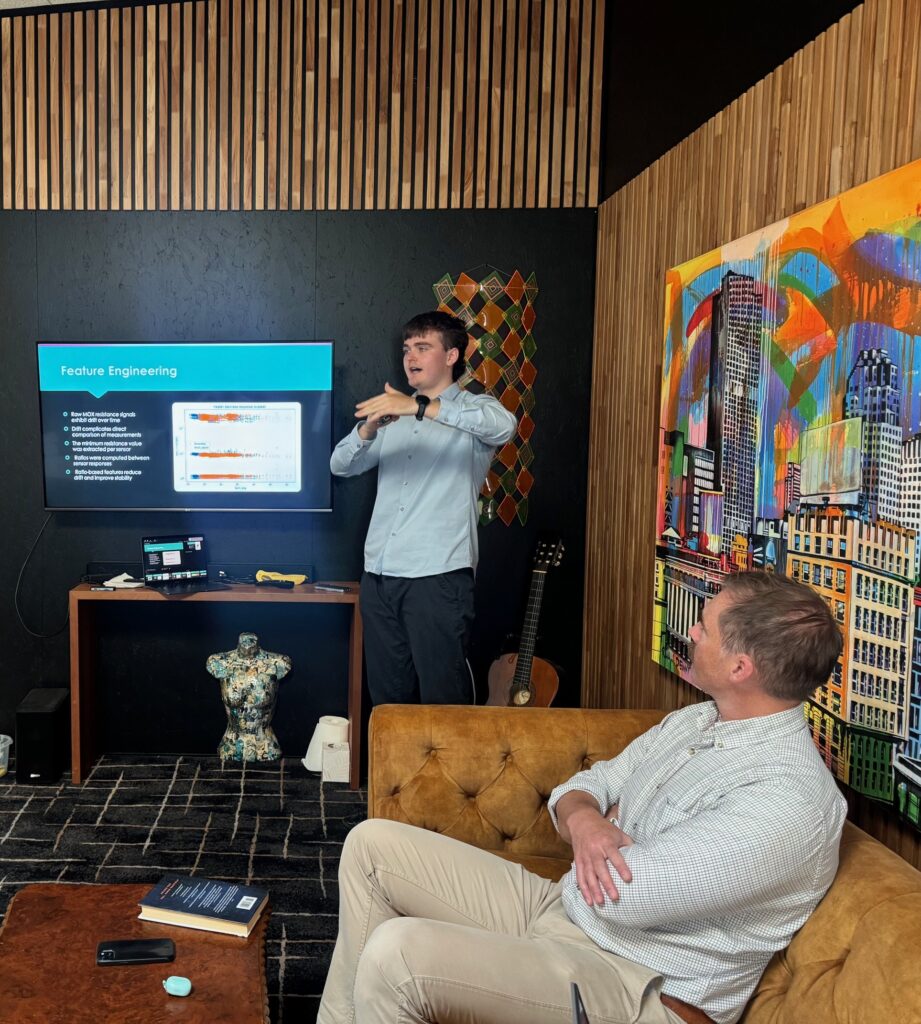
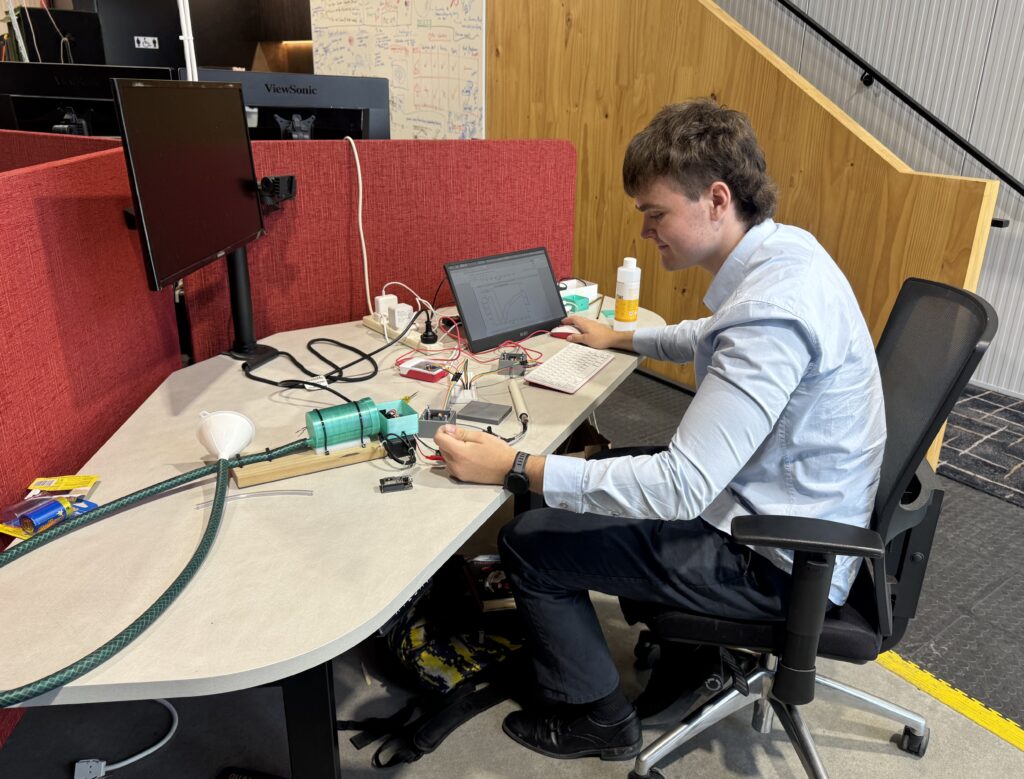
Zach was investigating MOX sensor dynamics – improving the sensor’s ability to distinguish certain chemicals. In practical terms, Zach designed a testing setup where a voltage-driven pump injects gas through a chamber, where sensors connected to a computer detect and record chemical responses. Zach developed the coding required to capture and process the data, analysing how quickly a gas moved through the chamber, when readings peaked and how they dissipated. Those timing patterns help distinguish between different chemicals — adding another layer of data to HumBio’s ScentGraph platform.
HumBio is currently planning pilots and is engaging with a range of industrial verticals ranging from monitoring fermentation through to odour mapping. “It’s basically detecting early signs of risk that has significance for operational efficiency, so that it can recover value that would otherwise be left on the table,” says Aaron. “Our whole ScentGraph proposition is that we basically detect the unseen early, but then provide the results and operational insights in real-time. It’s very much an industrial automation platform.”